Quantum Darwinism: The radical theory explaining why the macro world isn't as weird as atoms
A fascinating theory suggests that “survival of the fittest” doesn’t just apply to biology — it’s the reason our everyday world doesn’t behave like a quantum fever dream
A bizarre extension of Charles Darwin’s evolutionary theory into the subatomic realm could finally explain why our everyday world doesn’t behave like a quantum fever dream.
At the microscopic level, the universe operates under a set of rules that completely defy common sense. According to the laws of quantum mechanics, subatomic particles can exist in multiple states or places simultaneously—a phenomenon known as quantum superposition.
Yet, in our macroscopic, everyday world, things are decidedly normal. A coffee cup is either on the table or in your hand, but never in both places at once. This glaring disconnect between the quantum realm and classical reality has baffled physicists for a century, famously encapsulated by Erwin Schrödinger’s 1935 thought experiment involving a cat that is simultaneously dead and alive.
Now, a compelling framework known as Quantum Darwinism is gaining experimental traction, suggesting that the classical world we experience is simply the result of natural selection on a subatomic scale.
Survival of the fittest quantum states
To understand why the macro world isn’t weird, physicists first point to a process called quantum decoherence, which was initially formulated in the 1970s. Decoherence dictates that when fragile quantum systems interact with their surrounding environment (like air molecules or photons), their delicate superpositions collapse into a single, definitive classical state.
But decoherence didn’t explain how the environment chooses which specific classical state a particle should settle into, nor how multiple observers can all agree on what they are seeing.
Enter Wojciech Zurek, a theoretical physicist at Los Alamos National Laboratory, who first formalized the theory of Quantum Darwinism in 2003. Zurek proposed that the environment doesn’t just destroy quantum weirdness; it actively selects and amplifies specific, robust quantum states while wiping out the fragile ones.
According to Zurek’s theory, out of the infinite possibilities available to a quantum system, only a few “fittest” states survive their interaction with the environment. Physicists refer to these survivors as “pointer states,” because they act like the needle on a measuring dial, pointing to a fixed, objective reality.
The environment as a witness
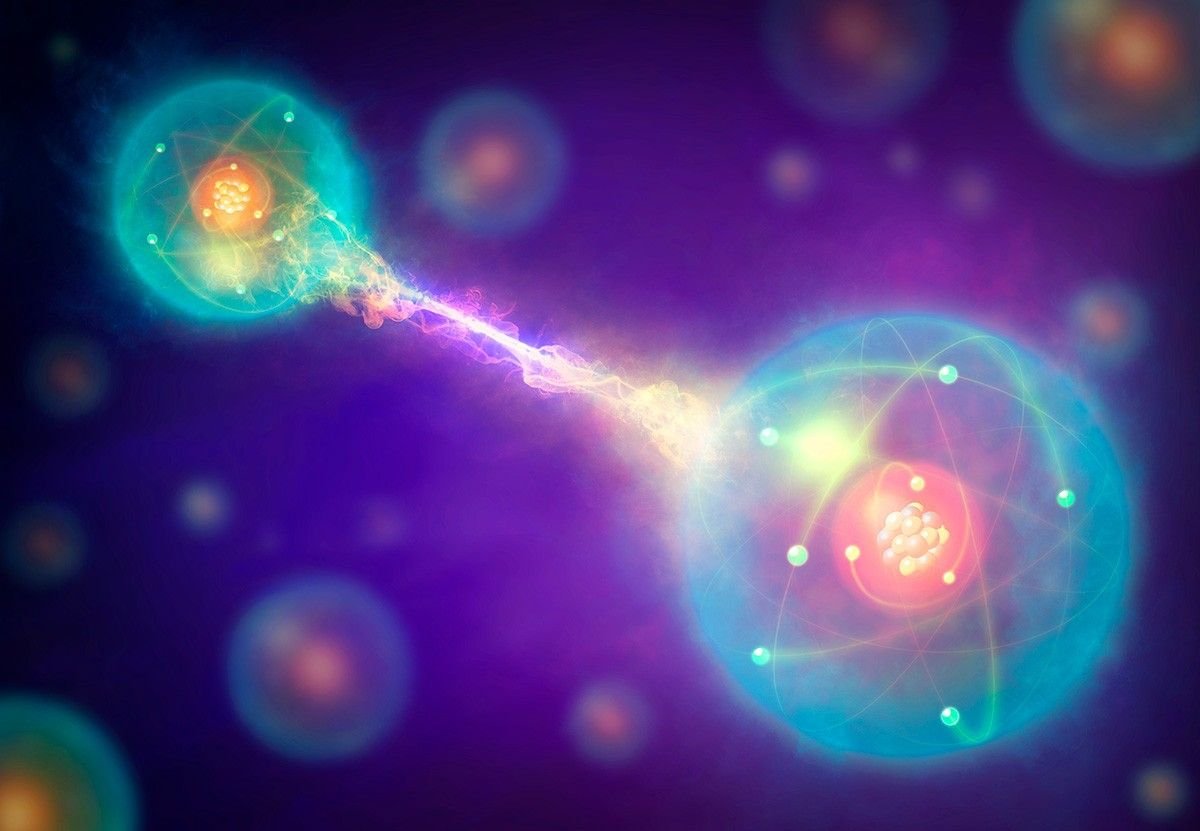
Quantum Darwinism introduces a radical shift in how we view the void around us. Rather than being empty space, the environment is a massive billboard constantly broadcasting information.
Here is how the subatomic natural selection breaks down:
Interaction: A quantum system (like an electron) interacts with environmental particles (like stray photons).
Imprinting: The robust pointer states of the electron leave an imprint of their properties on the photons.
Replication: Just as successful genes replicate in biological evolution, the information about these pointer states is copied millions of times across the environment.
Observation: When you look at an object, you aren’t directly interacting with its quantum particles. Instead, you are intercepting a fraction of these environmental copies. Because the pointer state has made so many identical replicas of itself, you and anyone else looking at the object will perceive the exact same classical properties.
Testing the quantum jungle
For years, Quantum Darwinism remained purely theoretical because detecting the subtle imprints a quantum system leaves on its environment requires impossibly precise technology. However, recent breakthroughs have finally allowed scientists to test this subatomic natural selection in the lab.
In late 2018 and 2019, three independent groups of researchers successfully observed Quantum Darwinism in action.
One team, led by Fedor Jelezko at Ulm University in Germany, tracked the evolutionary process using a nitrogen-vacancy center—a tiny, atom-sized defect trapped inside a diamond crystal. They observed how the defect’s quantum spin interacted with a surrounding “environment” of carbon atoms. Just as Zurek’s theory predicted, the researchers found that the carbon atoms successfully copied and preserved the defect’s most robust quantum state.
Concurrently, a separate team led by Jian-Wei Pan at the University of Science and Technology of China used clustered photons to achieve a similar result, confirming that information about a single quantum particle is redundantly burned into the environment.
A bridge to objective reality
These experiments are monumental because they begin to bridge the final gap between the quantum and classical worlds. The data suggests that classical reality—the solid, predictable world we navigate every day—is essentially a consensus built from the surviving remnants of a harsh quantum environment.
While researchers acknowledge that scaling these experiments up from a few atoms to macroscopic objects remains a major technological hurdle, the underlying mechanics of Quantum Darwinism have proven their merit. It seems that the universe, much like life on Earth, operates on a fundamental rule: adapt and replicate, or fade away.