The “Moving Sofa Problem”: The deceptively simple geometry puzzle that has stumped mathematicians for decades
A new and over 100-pages of proof may have finally solved a 60-year-old mathematical mystery about navigating a couch around a 90-degree corner.
Almost everyone has experienced the frustration of trying to maneuver a heavy piece of furniture around a tight corner. This universal struggle—famously immortalized by Ross Geller shouting “Pivot!” in the sitcom Friends—is also the basis of a rigorous mathematical conundrum known as the “moving sofa problem.”
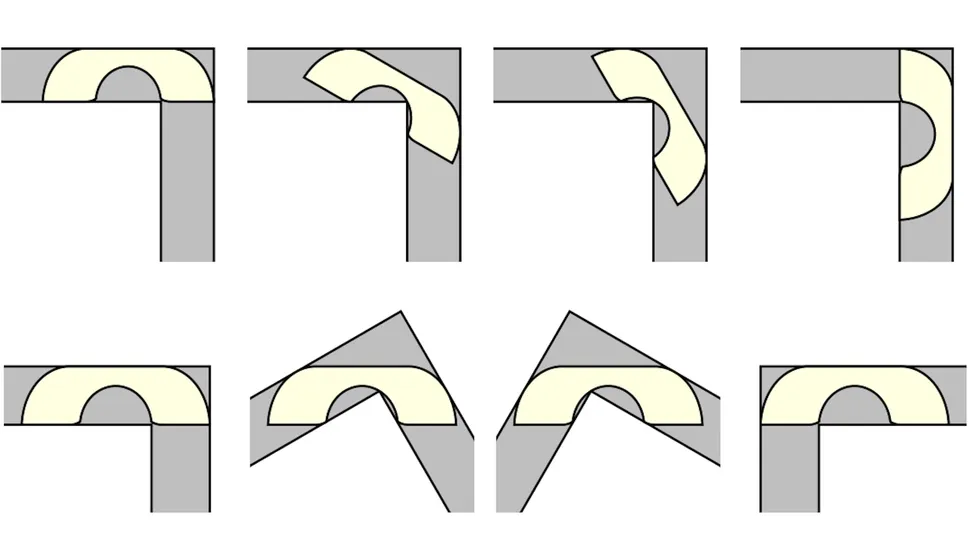
First formally proposed by Austrian-Canadian mathematician Leo Moser in 1966, the puzzle asks a deceptively simple question: What is the rigid two-dimensional shape of the largest area that can be maneuvered through an L-shaped planar corridor of unit width?
For decades, the exact value of this maximum area—referred to by mathematicians as the “sofa constant”—remained an unsolved open problem.
Pivoting towards a solution
To understand the complexity, mathematicians start with simple shapes. A unit square can easily slide through the corner, yielding an area of 1. However, if you allow the shape to rotate, a semicircle with a radius of 1 can pivot around the corner, offering a larger area of pi/2, or approximately 1.57.
In 1968, British mathematician John Hammersley realized that by combining rotation and translation, a much larger shape could be formed. He designed a shape resembling an old-fashioned telephone handset, consisting of two quarter-circles and a rectangular block with a smaller semicircular hole removed. Hammersley’s shape achieved an area of 2/pi+pi/2, roughly 2.2074.
The champion sofa
Hammersley’s design held the record until 1992, when Joseph Gerver, a mathematician at Rutgers University, derived a slightly larger shape. Using complex differential equations, Gerver constructed a shape bounded by 18 distinct curve sections. This new shape bumped the sofa constant up to roughly 2.2195.
Gerver strongly conjectured that his 18-curve shape was the optimal solution, but he was unable to definitively prove that no larger shape could exist. For over thirty years, Gerver’s sofa sat as the undisputed but unproven champion.
During that time, researchers sought to establish the absolute maximum possible size of the corridor’s occupant. In 2018, mathematicians Yoav Kallus and Dan Romik used a computer search utilizing discrete rotation angles to establish a new mathematical upper bound, capping the sofa constant at exactly 2.37. Romik also explored an “ambidextrous” variant of the problem—finding a sofa that can navigate both left and right 90-degree turns—and derived an 18-piece shape with an area of roughly 1.64495.
Closing the case
While bounds were tightening, the definitive proof of Gerver’s shape remained elusive. However, the mystery may have recently reached its conclusion. In November 2024, mathematician Jineon Baek uploaded a monumental more than 100-page preprint paper to arXiv, claiming to finally prove that Gerver’s value of 2.2195 is strictly optimal.
While Baek’s proof—which involves intricate topological and geometric arguments—has been navigating the rigorous peer-review process, it has brought fresh excitement to the mathematical community. It highlights how even the most basic spatial questions can require decades of advanced calculus to definitively answer.