The 'Wonder Material' Is Finally Here: How Graphene is Quietly Entering the Mainstream World

by Gaurav Kumar Tandon on 30th June 2026
Remember, when two scientists won the Nobel Prize for isolating a single, atom-thick layer of carbon (graphene) from ordinary graphite. Heralded as a “wonder material” that is 200 times stronger than steel, lighter than paper, and highly conductive, it was supposed to revolutionize everything from batteries to space elevators overnight. Instead, it seemed to stall in the laboratory.
But now, over 15 years later, graphene is quietly making its way into the mainstream world. Here is how.
Environmental Remediation: Cleaning our waters and oceans
One of the most immediate mainstream applications of graphene is in environmental remediation. A recent peer-reviewed study in Flatchem (Elveiser) revealed that ultra-pure graphene produced using Chamber Explosion Method by HydroGraph Inc. can remove 100% of six different toxic organic dyes from wastewater in just 10 minutes. Because of graphene’s massive surface area, industrial contaminants adhere directly to the material. Even better, it can be recycled and reused multiple times with nearly zero drop in efficiency, offering a scalable solution to the massive pollution caused by the textile and pulp industries. And this technology is actively being expanded through its compounding partner programs.
Graphene is also making waves in the maritime shipping industry. The Overseas Shipholding Group (OSG) recently adopted a specialized graphene-based propeller coating, developed by Graphite Innovation & Technologies (GIT), for its fleet of crude oil tankers. The slick coating, known as XGIT-PROP, dramatically reduces underwater hydrodynamic friction. Ships require less propulsion power to travel at the same speed, significantly slashing both fuel costs and carbon emissions. This aligns with broader industry pushes for graphene-based marine coatings. Similarly, companies are developing graphene-infused “Glubricants” that drastically reduce friction in heavy machinery, proving that the material’s structural lubricity is finally ready for the market.
Defense and Space
Beyond environmental efforts, governments and militaries are utilising graphene’s legendary strength. Premier Graphene recently secured two mission-critical contracts to supply the Mexican military with advanced materials, including tactical belts and nylon-cotton ripstop fabric. By integrating graphene directly into these fabrics, manufacturers can create military-grade gear that is incredibly lightweight yet highly durable. Premier Graphene is also exploring further applications for the material in the space and aerospace sectors, where reducing payload weight without sacrificing structural integrity is paramount.
Next-gen computing
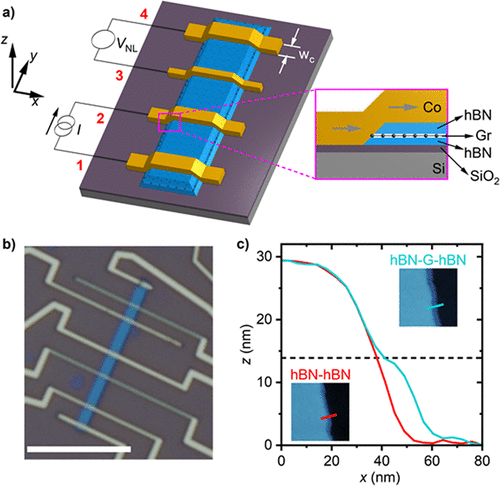
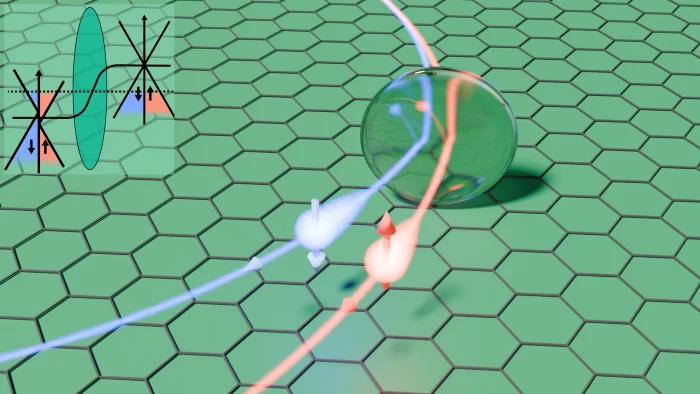
On a microscopic scale, graphene is also fulfilling its early promises for next-generation computing. A landmark study published in the journal Nano Letters demonstrated a new architecture for “spintronics” — utilizing the spin of electrons for quantum-based computation. By using one-dimensional (1D) contacts in fully encapsulated graphene, scientists were able to inject and tune electron spin signals at room temperature with unprecedented mobility. Just as researchers are finding ways to make computer processors operate thousands of times faster without generating waste heat, these high-quality graphene channels could serve as the foundation for blisteringly fast, ultra-low-power logic devices.
Overcoming the manufacturing bottleneck
For years, the primary barrier preventing graphene from reaching the mainstream was industrial scalability. It was easy to produce high-quality graphene flakes under a microscope, but manufacturing continuous sheets for commercial use proved incredibly difficult and expensive.
However, engineers have recently cracked the code by borrowing techniques from traditional newspaper printing. The adoption of continuous “roll-to-roll” production methods — where foil is fed continuously through high-temperature chemical vapor deposition furnaces — allows manufacturers to produce long, continuous sheets of high-quality graphene at an industrial scale. This continuous roll-to-roll synthesis, combined with new advancements in integrating graphene into carbon fiber manufacturing, has finally bridged the gap between the laboratory and the assembly line.
By solving the synthesis and scalability puzzle, scientists have ensured that the wonder material of 2010 is finally becoming the industrial workhorse of the future.
Article Sources:
ACS Nano Letters: Tunable Spin Injection in High-Quality Graphene with One-Dimensional Contacts (https://pubs.acs.org/doi/10.1021/acs.nanolett.1c03625)
Water Canada: Study finds Hydrograph graphene removes toxic dyes from wastewater within minutes (https://www.watercanada.net/study-finds-hydrograph-graphene-removes-toxic-dyes-from-wastewater-within-minutes/)
Hydrograph: Compounding Partner Program (https://hydrograph.com/lp-compounding-partner-program/)
Green Marine: OSG adopts graphene for cleaner oceans (https://green-marine.org/stayinformed/news/osg-adopts-graphene-for-cleaner-oceans/)
Advanced Carbons Council: GIT pushes graphene-based coatings (https://advancedcarbonscouncil.org/blogpost/2151389/509533/GIT-pushes-graphene-based-coatings)
Graphene MG: Glubricant Products (https://graphenemg.com/graphene-products/glubricant/)
GlobeNewswire: Premier Graphene Expands Strategic Position Following Initial Mexico Military Contract (https://www.globenewswire.com/news-release/2026/05/05/3287782/0/en/Premier-Graphene-Expands-Strategic-Position-Following-Initial-Mexico-Military-Contract.html)
Premier Graphene eyes space and aerospace applications: (https://www.barchart.com/story/news/2598244/premier-graphene-eyes-space-and-aerospace-applications)
Continuous roll to roll production: (https://www.azonano.com/article.aspx?ArticleID=6094)