The deep-sea “shadow” trick: Why some glowing sharks use bioluminescence to become completely invisible
A specialized belly-glow allows massive deep-sea sharks to erase their own silhouettes, rendering them entirely invisible to predators lurking below.
The deep ocean isn’t a pitch-black wasteland; it’s a neon light show. Estimates suggest that between 80% and 90% of all deep-sea creatures can produce their own light, a chemical process known as bioluminescence.
While glowing jellyfish or anglerfish get most of the attention, sharks are secretly pulling off some of the most impressive light-based magic in the ocean. Only two primary families of deep-sea sharks—the kitefin sharks (Dalatiidae) and the lantern sharks (Etmopteridae)—possess the confirmed ability to glow. Together, these groups account for about 12% of all described shark species.
The “counterillumination” invisibility cloak
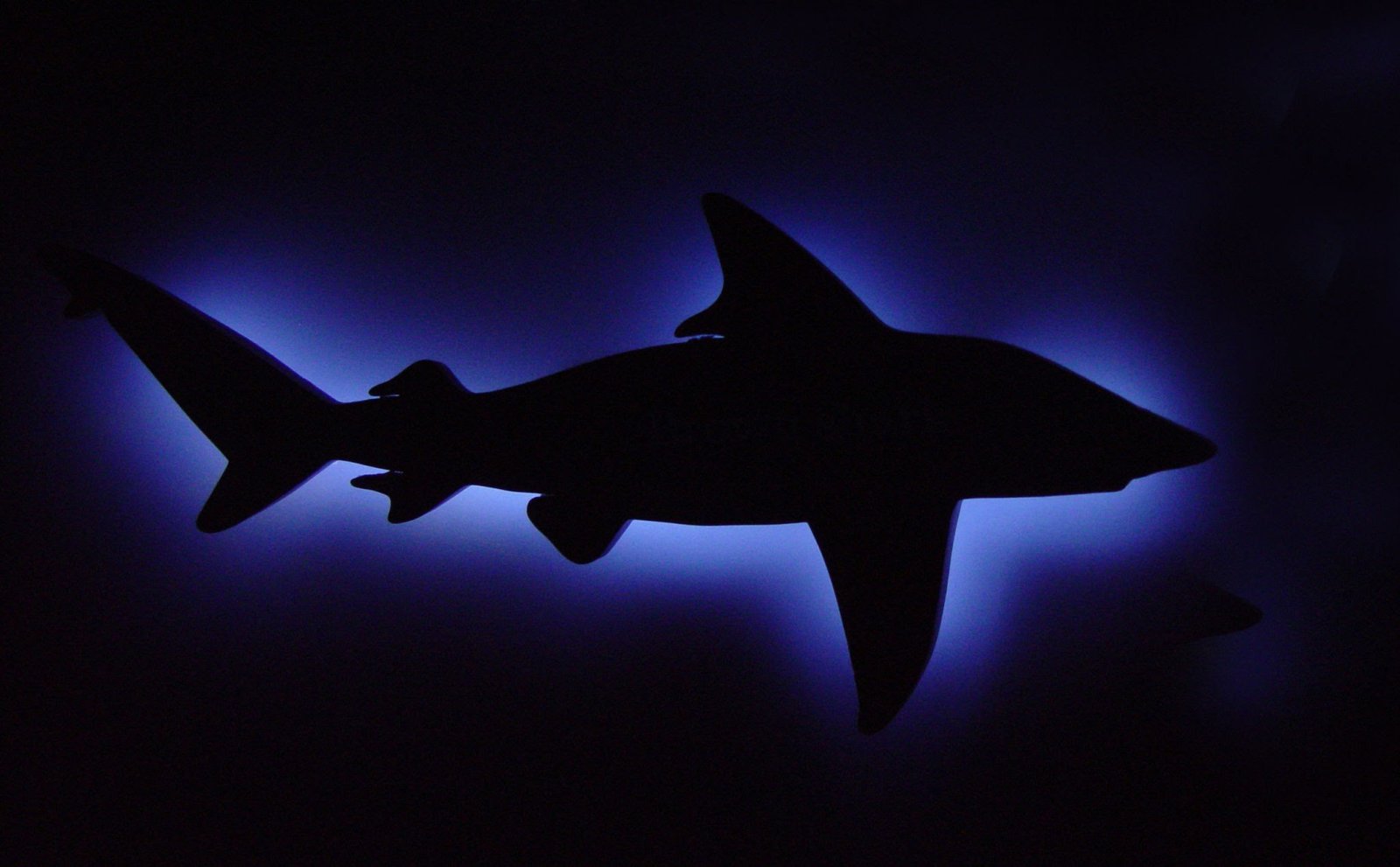
It might seem counterintuitive to light up if you want to hide from larger predators, but these sharks use a highly specialized camouflage technique called counterillumination.
In the ocean’s “twilight zone” (between roughly 650 and 3,300 feet deep), residual sunlight filters down from the surface. To predators looking upward, an unlit shark would cast a stark, dark silhouette against this faintly lit water.
To erase this shadow, glowing sharks have specialized light-emitting organs called photophores concentrated heavily on their bellies. These organs emit a blue-green light that perfectly matches the intensity and wavelength of the downwelling sunlight. To anything swimming beneath them, the sharks blend seamlessly into the background, becoming effectively invisible.
Hormonal light switches and giant glowing sharks
This evolutionary trick isn’t just limited to tiny, bite-sized species. In 2021, a breakthrough study published in Frontiers in Marine Science documented bioluminescence in the kitefin shark (Dalatias licha) for the very first time off the coast of New Zealand. Reaching nearly 6 feet (1.8 meters) in length, the kitefin shark is currently the largest known luminous vertebrate on Earth.
The mechanics behind their glow are just as fascinating as the camouflage itself. The 2021 study revealed that, unlike some marine animals that rely on a symbiotic relationship with glowing bacteria, these sharks generate their own light organically. Even stranger, their bioluminescence is uniquely controlled by hormones like melatonin and prolactin, rather than directly by the nervous system.
Maintaining this invisibility requires constant effort. Because the light produced by a shark’s photophores generally stays at a relatively constant intensity, it is hypothesized that some species must physically migrate to different depths throughout the day. This vertical migration ensures their belly-glow continually matches the changing ambient sunlight above them, allowing these deep-sea hunters to lurk entirely undetected in one of the planet’s most extreme environments.