The Laser and the Jungle: How LiDAR just uncovered a massive 2,500-year-old megacity in the Amazon
A sprawling network of ancient settlements and roads in Ecuador’s Upano Valley is changing everything we know about early Amazonian civilizations.
Archaeologists have discovered a sprawling 2,500-year-old megacity hidden beneath the canopy of the Amazon rainforest.
For decades, scientists believed that ancient Amazonian populations lived primarily as small, nomadic tribes or in modest, scattered huts. However, a groundbreaking study published in the journal Science reveals a densely populated, agrarian-based civilization that completely alters our understanding of the region’s cultural heritage.
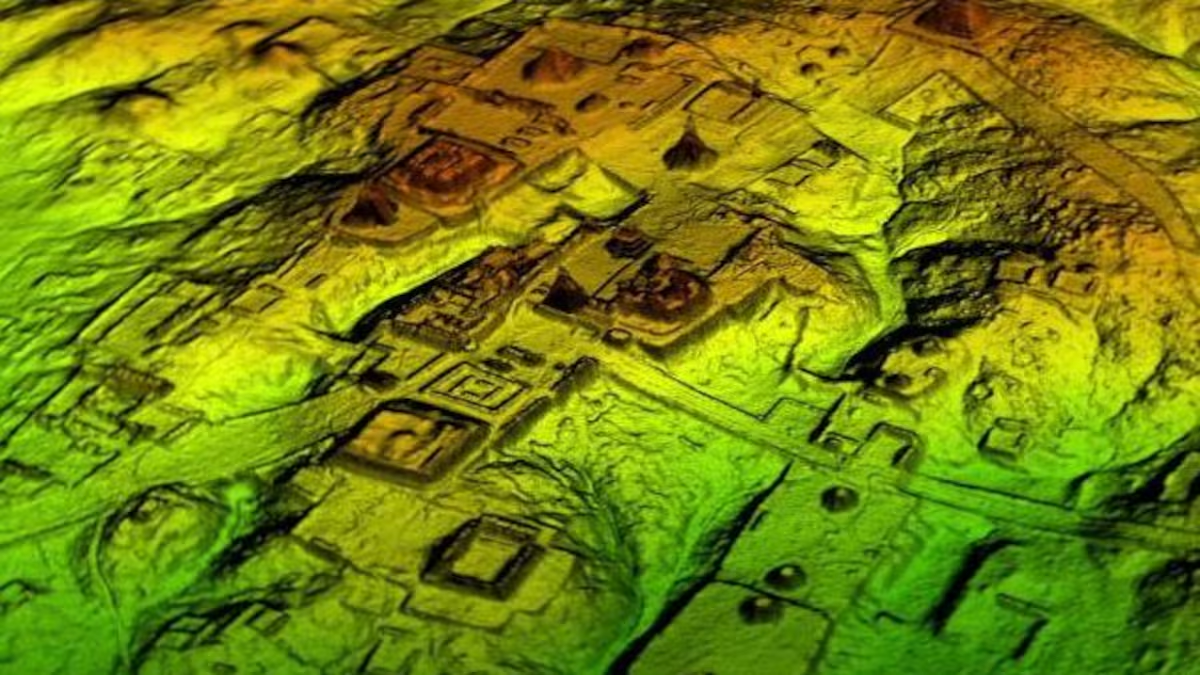
To pierce the dense jungle canopy, a research team led by Stéphen Rostain from France’s National Center for Scientific Research (CNRS) relied on LiDAR (Light Detection and Ranging). This remote-sensing technology bounces laser pulses from an aircraft to the ground, allowing scientists to map hidden topographical features that are invisible to the naked eye.
Piercing the canopy
The LiDAR mapping covered a 300-square-kilometer (115-square-mile) area situated in the eastern foothills of the Andes, near the active Sangay volcano. The resulting data uncovered more than 6,000 rectangular earthen mounds and plaza structures. Because finding suitable stone in the Amazon was challenging, the builders constructed these massive platforms entirely from earth and clay.
These mounds formed the foundation of at least 15 distinct settlements connected by an astoundingly complex system of roadways. The largest of these ancient roads measured up to 10 meters (33 feet) wide and stretched for 10 to 20 kilometers (6 to 12 miles) in straight lines across the landscape.
Radiocarbon dating from traditional archaeological excavations in the area indicates that the Upano people inhabited these cities between roughly 500 B.C. and A.D. 300 to 600. During its peak, this sprawling metropolis is estimated to have housed anywhere from 10,000 to 30,000 people—making it comparable to the population of London during the Roman Empire.
A sophisticated agrarian society
The sheer scale of the Upano Valley settlements fundamentally rewrites the history of human occupation in the Amazon. Between the residential and ceremonial platforms, the LiDAR scans revealed a grid-like network of agricultural fields and deep drainage canals designed to manage the waterlogged soil. The region’s rich volcanic soil allowed these ancient farmers to cultivate crops like maize, sweet potatoes, and manioc, which supported the massive urban population.
While researchers have recently discovered other pre-Columbian earthworks in Bolivia and Brazil, the Upano Valley site is currently the oldest and largest example of urbanization ever found in the Amazon. This monumental discovery proves that ancient Amazonia was home to complex, diverse societies, urging scientists to entirely rethink their preconceptions of the region’s indigenous history.